
Engineers Should Learn To Type
Read about my journey from hunting and pecking 60 WPM to touch typing 100 WPM in 5 months.

Around January 2021, I was a university student taking remote courses during the pandemic. I had just landed a software engineering internship at MongoDB and was looking for ways to prepare.
Somehow, I stumbled upon two well-known blogs about the importance of learning to type:
Programming’s Dirtiest Little Secret by Steve Yegge (caution: Steve Yegge’s writing style is not for everyone)
As Jeff Atwood says in his blog:
“We are typists first, and programmers second. It's very difficult for me to take another programmer seriously when I see them using the hunt and peck typing techniques. Like Steve, I've seen this far too often.”
I was the type of person he was referring to in the quote above.
In elementary school, I did have computer classes. We were supposed to learn how to type, but most kids at that age (including me) played games instead.
As a result, I developed a strange way of typing. By using some of my fingers (not all ten!), none of which were on the home row, and looking down at the keyboard for tricky keys, I reached 50 to 60 words per minute (WPM). A miracle, I know.
After reading the blogs above, I was inspired to overhaul my typing.
As a goal, I wanted to be able to type 100 WPM (because 100 WPM is a nice round number). According to a 2018 paper titled “Observations on Typing from 136 Million Keystrokes“ by Dhakal et al., the average typing speed is 52 WPM, so 100 WPM would be well above average.
To confirm I could maintain this speed, my goal was to average 100 WPM on Monkeytype (a slick website for typing practice) over ten tests, with the language set to english 1k. I planned to practice typing for at least 15 minutes daily to reach this goal.
Learning to Type Again
Ironically, to learn touch typing (typing without looking at the keyboard), I started with websites designed for schoolchildren:
As is often the case when trying to break a bad habit, the first few weeks were painful. Instead of typing my usual 50 - 60 WPM, I regressed to 20 - 30 WPM with terrible accuracy.
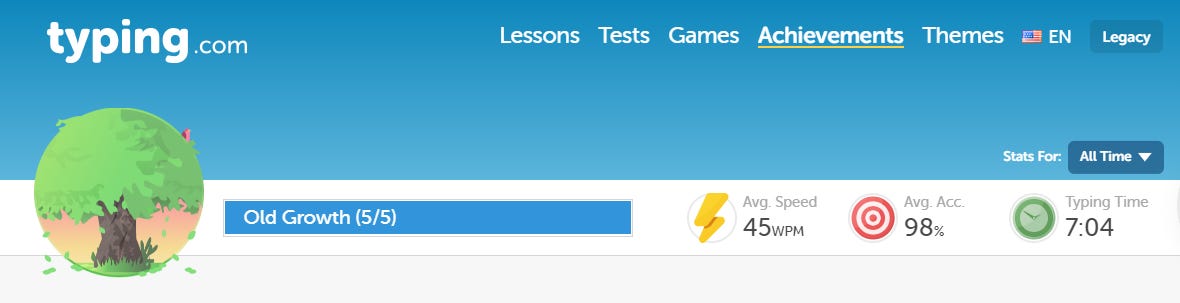
By the time I had finished most of the lessons on those websites, I had reached around 40 - 50 WPM. Here are my typing.com stats from 2021:
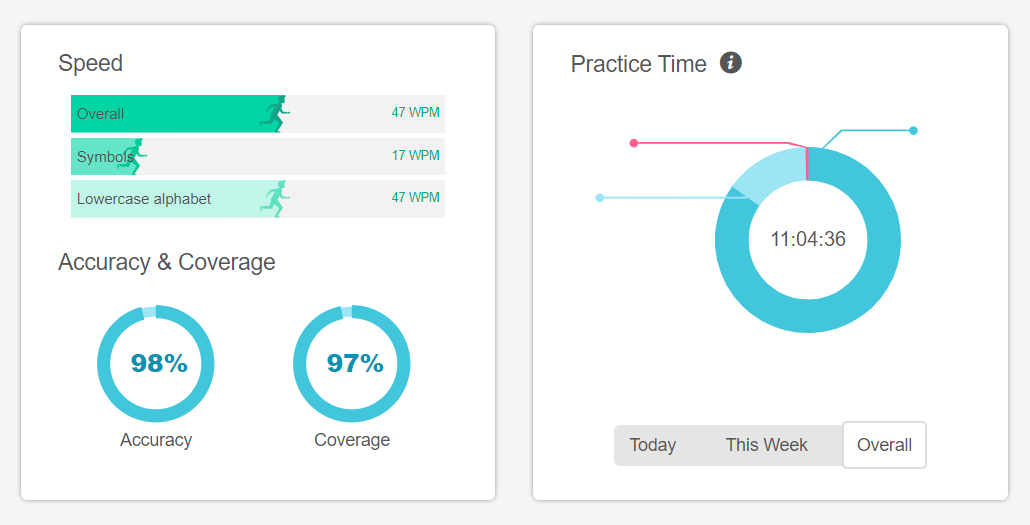
As you can see below, I had similar stats on typingclub.com:
Around this time, I felt I had exhausted these websites. Unlike the first few lessons, which drilled specific keys by making you type strings like fjfjjfjj, the last few required you to type sentences formed with English words.
Reaching 100 WPM
To better develop my muscle memory for common English words, I moved some of my training to Monkeytype around February 2021 (so a month had passed since starting this journey).
For variety, I revisited lessons from the two websites mentioned earlier. Still, I always ended sessions by doing ten one-minute typing tests and noting my average WPM.
At some point, I also bought my first mechanical keyboard (a Logitech K845 with brown switches). After some ad-hoc practice to get used to the new keyboard, I improved to 50 - 60 WPM.
From 60 to 100 WPM, I struggled with consistency. Look at the graph below, which plots all one-minute tests I’d ever taken. The solid pink line represents my ten-test average WPM:
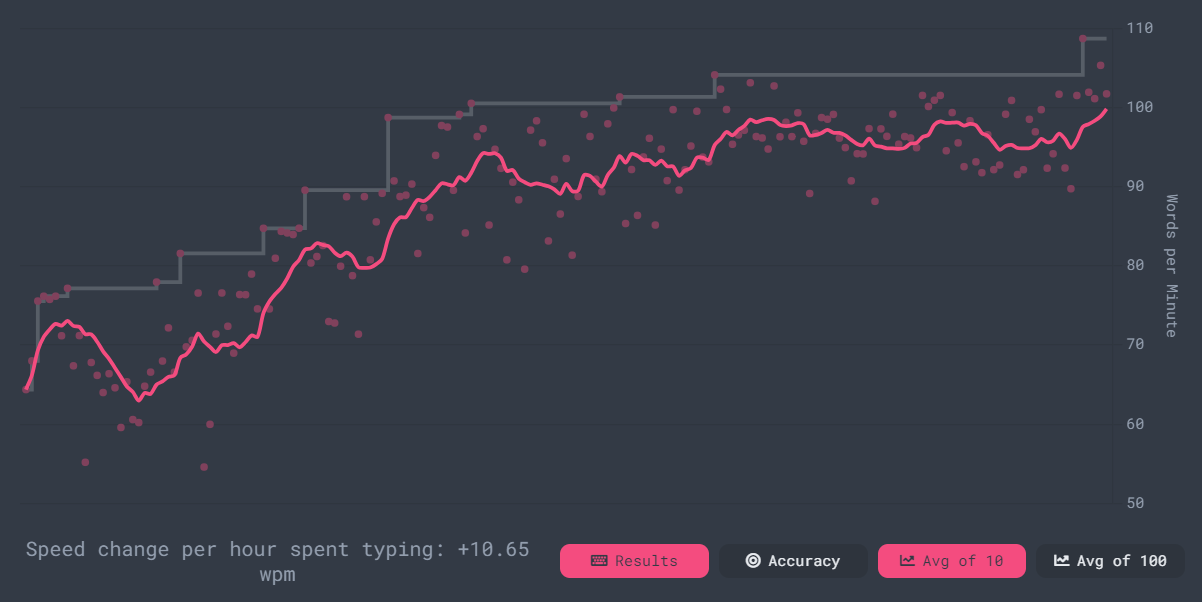
Initially, the gap between the highest and lowest WPM data points for the same day was wide. If I had to guess, two things likely contributed to the variance:
Cold fingers.
Fatigue.
Since it was winter, the first few tests were usually the worst because my fingers were not warmed up. After a few tests, I would get into a flow state for a while. Working at the edge of your comfort zone tires you out, so the last few tests were often no better than the first few.
I wasn’t sure how to overcome my consistency problem, but I devoted myself to daily practice. Over the next two months, my consistency improved as I became more comfortable typing at and maintaining faster speeds.
On April 29, 2021, I achieved my goal by ending the day with a ten-test average of 100 WPM:
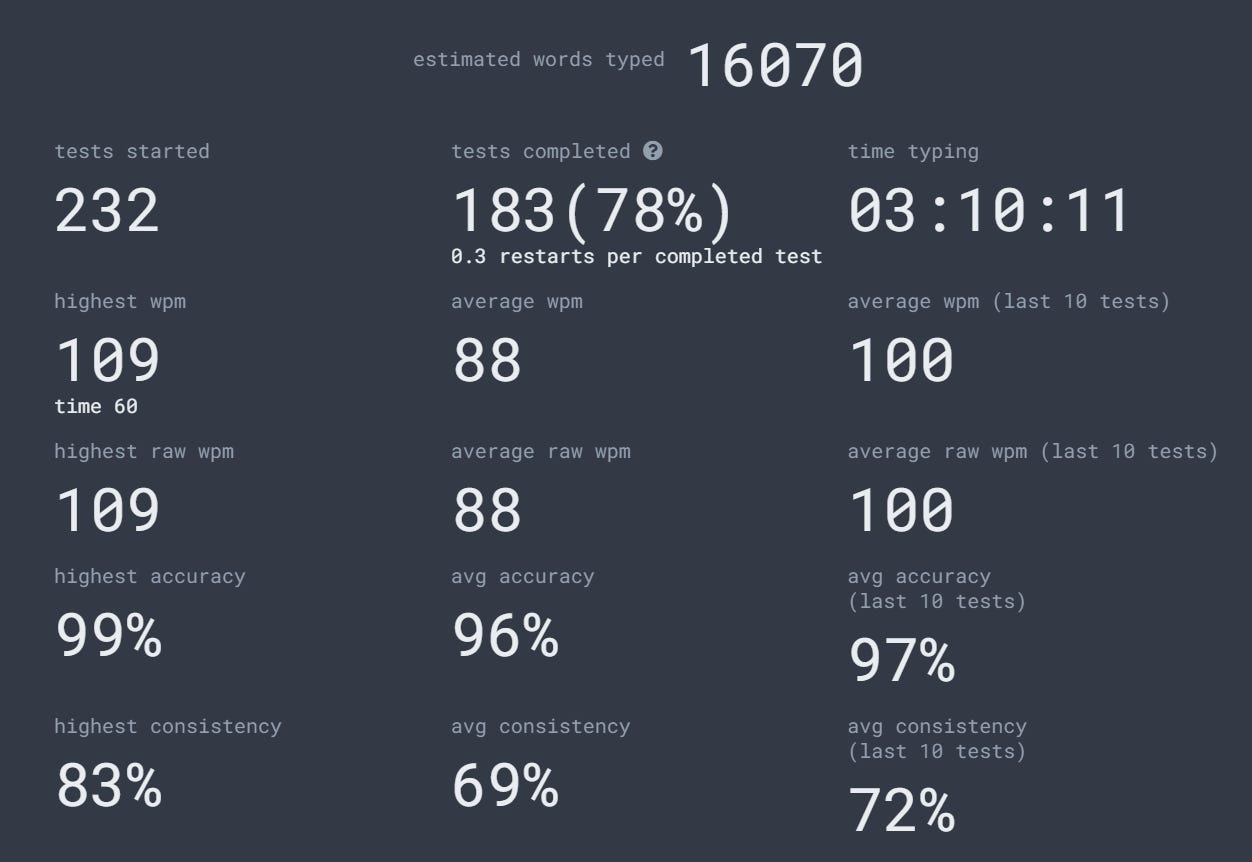
In total, the whole process took around five months, which was mindblowing to me. Besides learning to type faster, I had to undo more than a decade of bad typing habits.
I wouldn’t have believed you if you told me in January 2021 that I was only five months away from reinventing how I type.
The Benefits of Typing Fast
Since reaching 100 WPM, I am more productive working on a computer, regardless of the task. When you are comfortable on the keyboard, you become faster at:
Responding to emails.
Writing documentation.
Experimenting with ideas in code.
Using shortcuts.
Looking things up in your browser.
Typing practice can also teach you about self-improvement itself. Reflecting on those five months in 2021, here are my top three takeaways:
Focus on consistency over intensity. If your goal is long-term improvement, sustainable habits are essential.
Practice through plateaus. Plateaus are an inevitable part of self-improvement. Recognize them and figure out how to continue making progress.
Work at the edge of your comfort zone. To continue to grow, you need to continue to work at the boundary of what you are currently capable of.
To my readers: How fast do you type, and what did you do to get to that speed? Leave a comment down below!